Over the past few years, fundamental shifts in technology have accelerated inside and outside the classroom. AI, hybrid learning, and digital automation are now part of everyday schooling, yet formal education practices are still adjusting to their consequences.
This article examines the future of educational technology, where technology adds real value, and where it creates new risks. It offers a grounded view of how schools can adapt thoughtfully — without losing the human core of learning.
TL;DR
- Schools are adopting AI, hybrid learning, and automation faster than teaching methods, assessment models, and classroom norms can realistically adjust.
- Students now rely on AI to draft assignments and complete homework, forcing educators to reconsider what authentic learning and evaluation actually measure.
- Digital tools and AI expand access and operational efficiency but raise serious concerns around cognition, equity, privacy, and institutional security.
- The schools that succeed will use the future education technology to reduce administrative load while preserving human teaching, meaningful interaction, and clear accountability.
How education changed with technology
For most of history, education followed a steady, slow-changing model. When new technologies entered classrooms, they often caused disruption, and then schools adjusted practices as experience grew.
A brief timeline illustrates how education has changed with technology. Each shift required schools to rethink instruction, pacing, and assessment before long-term value became clear.
|
Technology |
Initial disruption |
Long-term outcome |
|
1500s: Printed textbooks |
Disrupted oral and handwritten instruction |
Standardized content and fixed learning pace |
|
1980s: Computers |
Challenged classroom-based instruction |
Expanded access to education beyond the classroom |
|
2000s: Learning management systems |
Altered assignment and assessment workflows |
Enabled continuous practice and feedback |
Today, schools face another adjustment period. AI, automation, and immersive tools raise familiar questions about balance. Educators now focus on thoughtful use that supports learning goals and preserves core academic skills.
Key forces shaping the future of education technology
Widespread AI adoption, hybrid learning becoming permanent, and expanded digital automation now shape daily classroom realities. Many schools continue to adjust policies, expectations, and instructional norms as these changes take hold.
Artificial intelligence and personalized learning
When people refer to artificial intelligence, or simply “AI,” they most often mean large language models, known as LLMs. These systems can process natural language, generate written responses, summarize content, and answer questions in real time.
Students increasingly rely on AI chatbots as a faster option than search engines and as an always-available academic assistant. For the first time, learners can access a form of personalized tutoring whenever they need. Some students also turn to AI to speed up homework, especially writing-based tasks. About 64% of teenagers report regular AI use.
Teachers show similar interest. Nearly 60% already apply AI to grading objective work, tracking progress, and creating practice materials.
Hybrid and flexible learning models
Hybrid learning has become a permanent feature of modern education. It blends in-person instruction with online and asynchronous coursework.
When properly implemented, this model gives students greater control over pace and timing. Learners can revisit recorded lessons, review difficult material, and take more responsibility for managing assignments.
Schools also gain flexibility. They can better serve students from varied socioeconomic backgrounds, rural or remote communities, multilingual households, and those with learning differences or health limitations.
But this model isn’t perfect:
- Some learners succeed in asynchronous formats, while others struggle with focus, motivation, and self-management
- Teachers often shift into proctoring roles when AI use is extensive, meaning they supervise, monitor progress, and grade work rather than actively teaching or designing lessons
- Reduced live interaction can weaken personal connections, which many students rely on to stay engaged
Hybrid learning is likely to remain. Its long-term value depends on how well schools protect human connection and support student discipline.
Automation and administrative efficiency
More schools now rely on small, targeted automations through AI and platforms such as Google Classroom, Microsoft Teams, and Moodle.
These systems reduce administrative load tied to daily instruction:
- Attendance is recorded across digital and in-person activities
- Objective, repeatable assessments require far less manual grading
- Templates and prebuilt structures cut time spent on course setup
- Standardized layouts support consistent navigation across subjects and grade levels
Technology in classrooms in the future: What will actually change?
Future classrooms will not appear radically different from today. However, daily learning will evolve through lesson delivery, student interaction, and the routine use of devices within classroom spaces and instructional practices.
Immersive learning
Immersive learning refers to the use of virtual reality (VR) and augmented reality (AR) headsets that place learners inside simulated environments or layer digital content onto the physical world. This approach is not new. Consumer VR gained traction during the 2010s, though early adoption remained limited.
As hardware improves, costs decline, and devices become more comfortable and practical for classroom use, adoption continues to rise. Market forecasts suggest the U.S. immersive training market could grow nearly tenfold by 2032, pointing to wider use in education.
In schools and universities, VR and AR can support learning through:
- Virtual science labs without physical equipment
- Historical simulations set within real events
- Digital field trips to remote or otherwise inaccessible locations
Smart infrastructure
Smart classroom infrastructure applies a network of connected devices, often called the Internet of Things (IoT), to make learning spaces respond more closely to real classroom activities. Many tools remain in early adoption, yet usage continues to expand as schools invest further in digital learning environments.
Smart infrastructure shows up in practical ways:
- Interactive displays, such as digital whiteboards that support shared problem-solving
- Connected lighting and climate controls, including systems that adjust light or airflow when rooms sit unused
- Text-scanning tools, such as handheld devices that read printed or handwritten text aloud for accessibility
- Smart access and attendance systems, including student cards that log classroom entry automatically
- Sensor-based wearable devices, including fitness trackers for physical education programs
Device-first learning environments
1:1 device programs already exist in many schools, but fully device-first learning environments remain ahead. To support daily instruction, schools need infrastructure that keeps devices charged and available at the start of every lesson. Over time, device lifecycle management in education will rely more on systems such as:
- Charging carts that keep devices powered and organized
- Shared charging stations that limit classroom disruptions
- Smart charging lockers that combine secure device storage, circulation, and charging
Future technology in education beyond the classroom
Libraries, maker spaces, and campuses continue to adapt as digital tools become more embedded in education:
- Libraries are expanding their role by offering AI training, safer digital workflows, and regular staff upskilling. Many also use generative AI to reduce time spent on routine tasks such as metadata cataloging and content organization.
- Maker spaces are becoming more connected to coursework. Students can now rely on 3D printing to prototype ideas, test designs, and refine projects.
- Across campuses, informal learning zones reflect everyday student needs. These spaces prioritize reliable Wi-Fi, accessible charging, and flexible layouts that support both individual focus and collaborative work between classes.
New trends in technology for education to watch
These future trends in education are likely to become part of everyday school operations:
- AI-driven personalization. AI systems increasingly tailor content and pacing to individual learners, helping educators target instruction more precisely. A recent systematic review of AI-based personalized learning studies reports “gains in student performance, knowledge, and engagement, as well as improvements in satisfaction and efficiency of learning.”
- Gamification and engagement mechanics. Gamified systems offer a time-efficient way to engage large groups of learners without constant instructor involvement. Progress tracking, challenges, and automated feedback help sustain participation at scale.
- Digital credentials and blockchain. Blockchain-based microcredentials are gaining traction as the labor market becomes more volatile and less predictable. Short, verifiable credentials allow learners to demonstrate specific skills much faster. This approach appeals to those who no longer see multi-year degrees as a safe investment in professions that may change or disappear in the near future.
- Accessibility and inclusive technology. Advances in AI and robotics are expanding inclusive learning through tools like real-time speech-to-text translation, adaptive interfaces for cognitive or motor needs, and robotic or AI tutors that personalize pacing, feedback, and support for diverse learners.
- Data privacy and ethical technology use. Greater reliance on cloud platforms and AI in education has intensified concerns around data privacy, surveillance, and the ethical use of AI by students.
- Sustainable and scalable ed-tech infrastructure. Long-term success in educational technology depends on infrastructure that supports device charging, storage, and lifecycle management.
Additional reading: Explore practical solutions and examples of the best mobile device management tools used by schools to support secure, scalable device programs.
Challenges and trade-offs of future educational technology
Despite the growing power of new technology and education initiatives, rapid adoption has introduced clear challenges that schools now confront across classrooms, staff workflows, and IT environments.
Diminished learning performance
Students have always looked for shortcuts to difficult work and occasionally cheated. Before AI, however, there were limits. Even when motivation was low, students still had to practice skills, write drafts, and work through problems on their own.
Today, students can shift a large share of thinking to AI tools. A KPMG report indicates that about 66% of students say they learn little when relying on AI. Yet many continue using it despite poorer outcomes.
A separate National Education Association study found that 72% of high school students use AI to complete assignments without fully understanding the material.
The long-term consequences raise concern. Research shows that frequent GPT users perform worse than non-users across neural, language, and behavioral measures.
Teachers are unprepared for AI-shaped learning
Teachers often lack clear instructional strategies, assessment frameworks, and institutional backing to keep learning meaningful in classrooms shaped by AI use.
A large-scale study of over 1,100 pre-university teachers found that “limited AI literacy” is strongly associated with anxiety, ethical concerns, and uncertainty about AI’s role in education. Many teachers express concern about maintaining pedagogical value as AI becomes part of everyday learning.
Digital divide
Increasing digitalization could widen the digital divide. Federal data shows that many U.S. households — particularly those with Black, Hispanic, or Indigenous students and those in rural areas — still lack reliable home internet access or personal devices.
Data privacy and security concerns
The emergence of gen AI created new security challenges:
- Personal privacy issues. Many users share sensitive information with chatbots without caution, which undermines basic expectations of confidentiality. For example, nearly 300,000 private conversations with Grok have been indexed on Google in August 2025.
- Cyberattackers now rely on LLMs. Between 2023 and 2025, synthetically generated text in harmful emails doubled, and attackers find new ways to automate social engineering.
- AI-driven espionage. In late 2025, Anthropic identified a sophisticated espionage campaign where agentic AI handled most of the attack process, from reconnaissance to data theft. It marked the first large-scale cyberattack with minimal human control.
For schools, unchecked AI use can quickly become a source of liability. Student data, staff credentials, and core systems are at the greatest risk of exposure.
What the future of educational technology means for schools
Educational technology will bring meaningful opportunities, but it will also add layers of complexity that schools must actively manage:
- For teachers: Some educators will intentionally limit AI use in the classroom. They may rely more on paper-based assignments, in-class writing, discussion, and oral assessment to protect the development of core thinking, reasoning, and problem-solving skills.
- For administrators and IT teams: Leaders will concentrate on sustaining one-to-one technology in schools while introducing high-impact tools with clear instructional value. VR and AR will see more use in subjects such as history, biology, physics, and astronomy. At the same time, teams must define controls that restrict excessive or inappropriate AI use.
- For students: Many learners will continue testing boundaries by using AI to shortcut assignments. This pressure will force schools to rethink assessment design and academic integrity when AI remains constantly available.
Preparing for the future of technology in education
Schools must decide which forms of thinking, judgment, and understanding still matter when students can generate usable answers instantly with AI. The goal is not simply to restrict AI use, but to define where learning and effort remain essential.
Rethinking what learning is for
To remain meaningful in the age of AI, learning must move beyond memorization and output-focused tasks. Greater emphasis should fall on interpretation, reasoning, and the ability to evaluate, defend, and refine ideas rather than simply repeat them.
Schools will need to follow the same path taken when calculators became widespread. Tasks must test understanding instead of mechanical execution. Future-ready assessments will focus on areas where AI support does not replace human judgment:
- Problem framing
- Multi-step reasoning
- Real-world scenarios
- Oral explanation
- Reflective thinking
Effective change management in education helps align curriculum design, assessment expectations, and teacher support with these evolving demands.
Keeping humans at the center of learning
Technology should support classrooms, not replace them. Hybrid learning will work best when applied selectively, such as for special circumstances or clearly defined instructional needs.
It should not function as a substitute for in-person education, where daily human interaction builds social, emotional, and communication skills that students carry beyond school.
Optimization and automation, including AI, belong in narrow roles that reduce administrative burden rather than diminish the teacher’s input.
Schools must actively protect and strengthen the role of the human teacher. This includes better support, clear expectations, and meaningful incentives. No system can replace the social learning, judgment, and mentorship that real classrooms and committed educators provide.
Building technology-enabled infrastructure
As classrooms become device-first environments, schools need infrastructure that supports daily device use at scale without adding operational strain.
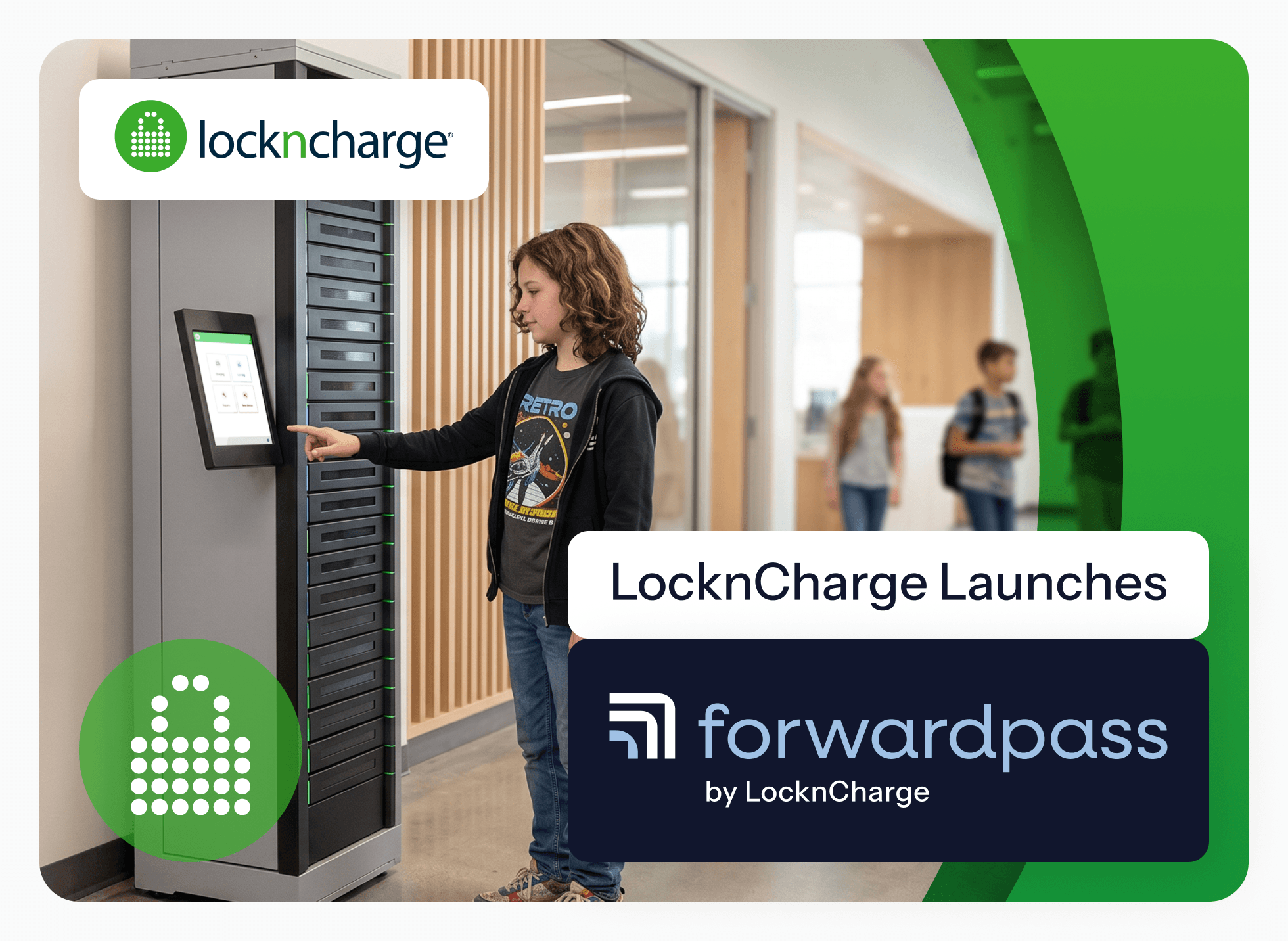
With adoption in more than 15,000 schools worldwide, the LocknCharge smart locker system provides an operational foundation for device-ready, technology-enabled classrooms:
- Built for school environments. Tamper-resistant steel construction with passive ventilation works best for classrooms, libraries, and administrative areas.
- Flexible capacity options. Configurations ranging from five to 23 bays allow schools to match locker size to enrollment, device volume, and physical space.
- Self-service device access. Integrated touchscreens allow students to check out, return, or report issues independently, which reduces staff workload and classroom interruptions.
- Policy-aligned workflows. Charging, short- or long-term loans, repairs, and deployments adapt to district policies, grade levels, and device programs.
- Age-appropriate authentication. QR codes and ID badges support fast, intuitive use for middle school and high school students.
- IT integrations. Compatibility with student information systems (SIS), service desks, and asset management tools, including Incident IQ, supports centralized visibility and reporting.
- Ongoing support. Guided onboarding, technical support, and dedicated success managers help schools maintain smart locker units.
Request a personalized demo to see how smart lockers support long-term device programs.
Bottom line
- As technology becomes unavoidable, the defining question for schools shifts from whether to use it to where it meaningfully belongs.
- Learning outcomes increasingly depend on how well schools protect human thinking, social interaction, and effort inside digital systems.
- AI and automation raise the cost of poor execution, making weak pedagogy and unclear boundaries more damaging than before.
- The schools that benefit most from technology will be those that treat it as quiet infrastructure, not as the center of education.
Author

.png)